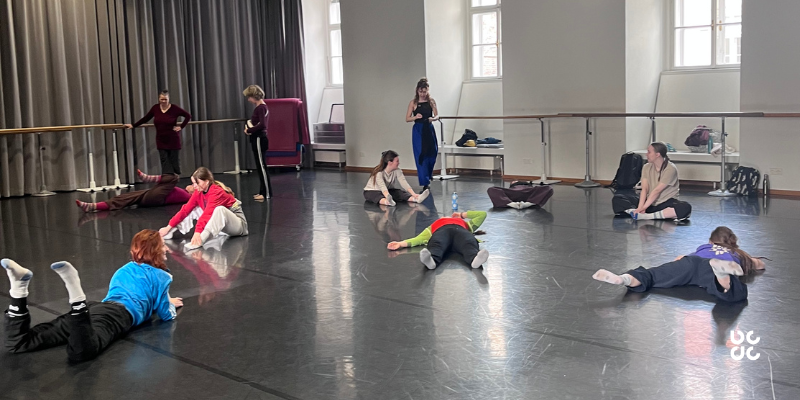
In March 2026, third-year students had the opportunity to visit Vienna for a week of professional development thanks to Erasmus+ support. The program focused on a practical and reflective approach to contemporary dance, combining technical training, improvisation and dramaturgical thinking. The Tanzquartier workshops approached the body and movement from different perspectives: Saskia Tindle’s ballet classes focused on anatomically conscious execution, use of space and musicality, while Lau Lukkarila’s improvisational and performative practices supported playfulness, contingency and risk-taking. Malcolm Manning’s class The Tuning Class focused on fine-tuning attention and bodily presence, while Anna Prokopová led a collective exploration of movement layers and sensory attention.
The third-year students participated in classes and workshops that focused on developing presence, attention and bodily sensitivity, while also being given the opportunity to deepen their personal movement language and take performative risks.
The practical training was complemented by the studio work of Tamara Vadas Zsófia, during which the third-year students worked on their own projects from a dramaturgical perspective. These opportunities provided space for critical dialogue, reflections and awareness of the creative processes. Ádám Czirák also joined the Wednesday joint opportunities, strengthening the theoretical and dramaturgical focus.
The program also included participation in the first seminar organized by Tanzquartier Wien. The title of the series is NOBODY: Now Bodies. At the first seminar, they were introduced to the basic concepts and methodology of the course, with a special focus on the role of the body in the creation of knowledge. The starting point of the session was that learning and teaching cannot be separated from the body, yet traditional educational situations often ignore this and prefer static, “disembodied” forms of knowledge.
During the session, we were introduced to the concept of embodiment, which interprets the body not only as an object of study, but also as a means of understanding. This was not only discussed theoretically by the team, but also experienced through movement-based exercises, which helped to connect sensory and intellectual approaches.
In addition, the students reviewed the main thematic directions of the course – such as performativity, coding, communal bodies, norm criticism and transformation – which will be elaborated in more detail in later sessions. The first session was thus primarily a kind of foundation, which marked out the critical and body-centered approach of the course.
During the week, third-year students gained a complex experience that strengthened technical development, creative thinking, and community learning.